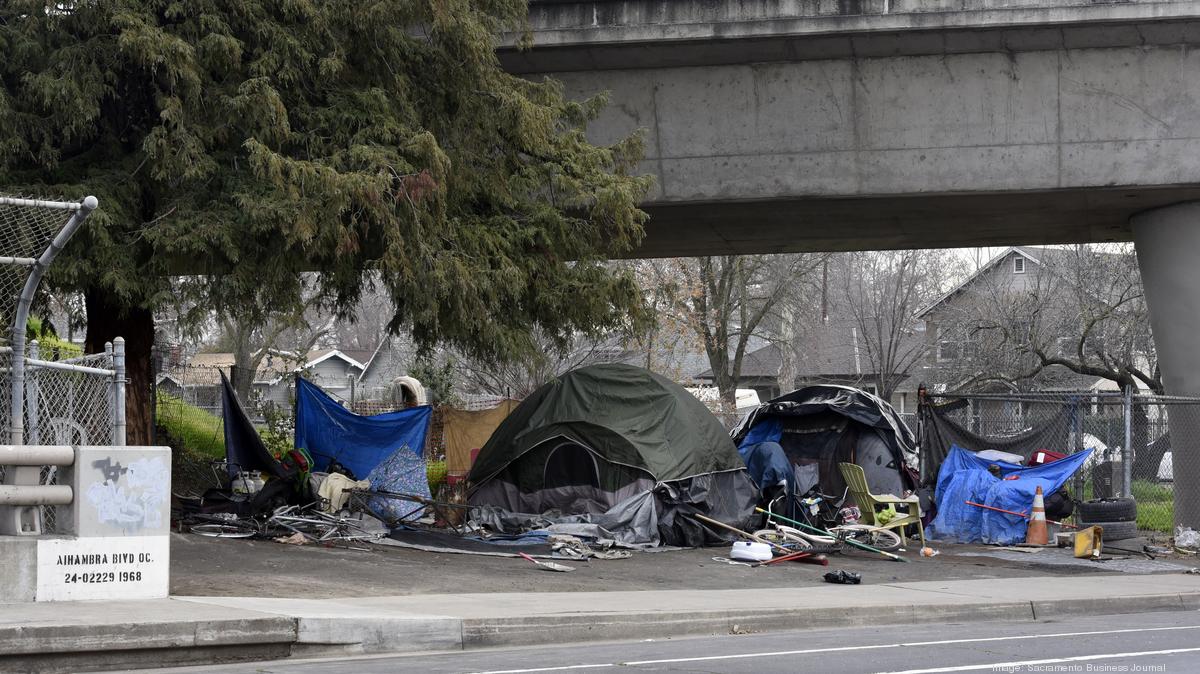

JUST FOR a moment, stop and think. On any given day, how many unhoused people do you see? How many do you drive past on street corners, walk past on sidewalks, or engage with outside storefronts? For most in Sacramento, in California, and in the nation, that number is bound to be high and gets higher year after year. 1
Many say that homeless people are lazy, and that’s why they are there out on the street. Others say they’re druggies and addicts—so there on the street they will stay. But those assumptions, often parroted by the media, omit crucial connections in a causal chain, only the end of which is homelessness and addiction. In the annals of publications such as The New York Times, The San Francisco Chronicle, and even The Sacramento Bee, one rarely finds mention of wealth inequality, urban planning, or social services in relation to homelessness. Instead, and perhaps because of these omissions, the prevailing winds are behind pro-punitive, pro-police responses.
For the very reason that the spending on police forces has never been higher in American history, and yet homelessness the same, one rationally concludes that such a response is not a solution, and such prevailing line of reasoning is an inhumane distraction. Let’s delve beyond it.
PERHAPS ONE of the factors most pertinent to the homelessness crisis has been rising wealth inequality, most often attributed to tax cuts for the wealthy, stagnant wages, and declining union prevalence.
Back in the eighties, some big changes occurred with the election of President Ronald Reagan, who advocated for a system called Reaganomics, championing lower taxes and loosened regulations for businesses and wealthy individuals. He professed that these policies would generate profits for the wealthy, assuming they would “trickle down” to the poor. Empirically, they did not.
According to the Pew Research Center, even disregarding income, wealth inequality more than doubled with taxation adjustments: “In 1989, the richest 5% of families had 114 times as much wealth as families in the second quintile. By 2016, this ratio had increased to 248”2
Many research groups also attribute this rise to collapsing union membership and wage stagnation. For example, the Michigan Journal of Economics reports that whereas 1 in 5 Americans were union members as of 1983, only 1 in 10 make up that group today.3 This erosion of union participation, which the source and others link to corporate union busting tactics, has meant a decrease in organized pressure to increase wages. So, while worker productivity has jumped up 85.7% since 1983, hourly pay has only risen 33.7%.4 In simpler terms, the workforce are being productive; they’re just not getting compensated appropriately in exchange.
Reflecting on this era and its repercussions in the present, civil rights lawyer Alec Karakatsanis writes in his book Copaganda, that “if the U.S. had remained as equitable as it was in 1975 for the next forty-three years through 2018, the bottom 90 percent of Americans would have earned an extra $47 trillion.”5 Thus, financial security is much weaker for the poorest majority than it would have been had policy not changed.
Taxes, alas, don’t tell the full story, as there are numerous and known methods through which the wealthy preserve, expand, and pass-on their wealth in ways that (1) cannot be taxed and (2) cannot be enjoyed by working class people, who do not have the time and resources, nor the homeless who cannot gain access to the internet, the stock market, advisers, and thus wealth generation and preservation. They say anyone can take advantage of these “tricks,” but that mindset omits the realities of working three jobs to make ends meet or living on the street. If anyone is not everyone, anyone is not equality. However veiled, anyone is a false narrative.
Here we see that the cause and effect of economic policy lends itself as an explanation as to why the homelessness crisis is so blaring today–why our own people are out on the streets. To an extent, these policies laid the groundwork for our present, where “more than half of Americans live paycheck to paycheck” and teeter “one crisis away from homelessness.”6 Surely, wealth inequality has everything to do with the crisis.
ANOTHER UNJUSTLY overlooked angle to homelessness is that of urban planning. Dissecting what we build, where we build, and for whom we build in our cities can reveal some key explanations for our current situation.
The words “affordable housing” fly around a lot in the California planning and development world. Conceptually, affordable housing refers to a unit of housing where a household occupying it spends under 30% of their income on said housing. Local, state, and federal funds support these endeavors.
However, comprehensive & specified investments in affordable housing or even immediate, temporary homeless shelters have not been forthcoming. With a lack of interest by officials, many communities have tried their hands at solutions. For example, the non-profit organization First Step Communities, with locations and programs in the Sacramento area, was founded in 2015 to provide shelter and counseling to the unhoused. Such projects aim to get people back on their feet, and they often receive some governmental funding. However, as First Step’s own website attests, there is a constant lack of “funding to produce sufficient and affordable permanent housing for the homeless population”7 So, despite the human value and verve of local solutions, without comprehensive funding & resources for widespread implementation, such solutions are simply bandages, while the problem at large gushes over.
Due to lack of profitability, developers in the private sector often balk at investment and partnership in affordable housing projects. In turn, local governments sometimes must go to great lengths to string private investors along to secure funding for development, often ending up with much less affordable or middle-income units than originally planned for or needed in the community.
In the background, developers and the real estate industry spend big time in local and state politics. By some estimates, California real estate interests have spent over $32 million “lobbying the state legislature and the executive branch in the past three years.”8 Nationally, the group OpenSecrets has pegged the amount of money spent by the real estate lobby in US politics at $152.97 million in the year 2024.9 An investigation by Mercury News further found that developers in one area of California spent over $600,000 “lobbying legislators to prevent requirements that would have required rents on [their middle-income housing] projects to be lower.”10
Here, the lobbying from real estate often pushes two narratives on housing. One is NIMBYism, taken from the acronym “Not In My Back Yard.” It opposes efforts to build more affordable housing under the belief that it will decrease property values and increase crime rates. NIMBYism, along with corporations like BlackRock buying up housing units while not filling them with residents, keeps the supply of housing low enough to drive up the price for it.11 YIMBYism—swapping that “no” for a “yes”—seems to be the opposite approach, but used by certain developers, it can result in a very similar conclusion. Whispering in politicians’ ears to reduce regulations on undeveloped land and approve housing construction can allow developers to get away with inundating localities with “new apartment construction” that is “at the top of the market, where luxury units command top prices from wealthy renters,” which Zillow has already found them to be doing.12 This brand of YIMBY approach produces luxury housing that is anything but affordable, effectively doing little to economize the housing situation.
Either way, greater profit is generated for developers as well as realtors, who get a percentage cut of what a house sells for. But in neither scenario does planning work for those who need it most—homeless and low-income individuals. While there is much to unpack here, even a brief analysis showcases how urban planning approaches impact homelessness in more ways than one.
THE FINAL lens through which we must analyze homelessness is our social services. Undoubtedly, our healthcare, mental counseling, and drug rehabilitation systems have as much to do with how individuals get out on the street as how they get off it.
For one, under our for-profit healthcare system, over 8% of people remain uninsured.12 What this means for those 26 million people is that when they need care, a full and often ridiculously high bill must be paid. Thus, an unexpected or emergency trip to the doctor could deliver crippling medical debt. For around 16 to 28 percent of adults, medical debt is a stark reality, and as one University of Washington study has found, such debt primarily drives housing instability and even extends periods of homelessness “by an average of two years.”13 So, after personal or family medical emergencies, medical debt can not only trigger an individual’s arrival on the street, but also lengthen their stay. I can’t see how one can chalk this up to laziness…
Mental health and drug rehab services are often cast aside in conversations of homelessness, even when articles raise the alarm about drug addiction and drug-related crime. A majority of the time, journalists and police stay surface level about drug use. Seldom do they reflect on how drug use relates to poverty–how the stress, hopelessness, and pain felt by poverty-stricken persons greatly increases vulnerability to drug use and addiction.14 Seen as a way to take the pain away, such drugs can feel like the only outlet. And yet hard substance use can greatly complicate job and housing retention, and deteriorate a person’s mental health. Once again, these factors push towards greater housing instability and homelessness.
For the vast majority of the poor and unhoused, to use drugs is not a frivolous choice, but one made increasingly difficult to resist as a result of the social conditions under which they are unceasingly trapped. And without outside help and intervention services, it is practically impossible to expect the homeless, and those among the homeless population with mental or addiction-related issues, to be able to pull themselves up out of their situations simply on their own.
Just think of the basics. To have income, you need to have a job. Are people likely to hire you if you haven’t showered? What if you don’t have access to clean or “work-appropriate” attire? If you have any sort of drug attachment, what are the odds you’re seen as a viable candidate for employment? Suppose (by some miracle) you get hired. Say, where does your employer send the money? Not to the home you don’t have, that’s for sure. Okay! Now you’ve collected the money in cash, but how do you manage to save it for the future and from theft? Common sense dictates the chance of a completely independent recovery in this reality is slim.
NOW MORE than ever, most politicians, journalists, and overwhelmingly police see the consensus around solutions to homelessness as increased police funding and criminalization. Governor Newsom himself has moved to criminalize homelessness in the wake of the Supreme Court ruling in Grants Pass v. Johnson. The governor’s order following the ruling encouraged cities to clear encampments and adopt “laws criminalizing behavior associated with being homeless—like sleeping in parks, even when no shelter is available,” as Axios reports.16 This policy adopted last year in many localities involves disappearing the possessions of encampment residents and dispersing the unhoused from certain areas. By doing so, many politicians think they are solving the crisis, when they are really just shifting the problem around and destroying all the possessions the unhoused have left.
Some California natives, including vocal housing advocates, have described these criminalization policies as especially cruel and ineffectual. And really, how could a plan to “solve” homelessness that sidelines issues of wealth inequality, urban planning, and social services be anything but?
Such factors need to be at the forefront of our conversations on homelessness, not featured in token or one-off journalistic pieces. Without them, our discussions on homelessness will continuously fail to grasp the gravity of the situation and connect the dots from the home to the streets. That’s why, each time I drive past another homeless individual I think not of an individual failure, but of a collective one. Our society—and the system—has failed them. The question all “free” media should ask, the one that will lead us to many viable answers, is why the system consistently fails so many?
Works Cited:
- “State of Homelessness Dashboard Sacramento – Monthly Data.” Sacramento Steps Forward, November 12, 2025. https://www.sacramentostepsforward.org/data-and-analytics/state-of-homelessness-dashboard/.
- Horowitz, Juliana. “Trends in Income and Wealth Inequality.” Pew Research Center, January 9, 2020. https://www.pewresearch.org/social-trends/2020/01/09/trends-in-income-and-wealth-inequality/.
- Kalasho, Malak. “Rising Economic Inequality in the US: Key Statistics and Root Causes – Michigan Journal of Economics.” Michigan Journal of Economics, 8 Feb. 2022, sites.lsa.umich.edu/mje/2022/02/08/rising-economic-inequality-in-the-us-key-statistics-and-root-causes/. Accessed 2 Dec. 2025.
- “The Productivity–Pay Gap.” Economic Policy Institute, 2024, http://www.epi.org/productivity%20pay-gap/. Accessed 2 Dec. 2025.
- Karakatsanis, Alec. Copaganda. 2025. The New Press, 15 Apr. 2025.
- United States Interagency Council on Homelessness. “Homelessness Data & Trends.” http://Www.usich.gov, United States Interagency Council on Homelessness, http://www.usich.gov/guidance-reports-data/data-trends. Accessed 2 Dec. 2025.
- “About Us | First Step Communities | Sacramento.” First Step Communities, 2014, http://www.firststepcommunities.org/about-us. Accessed 2 Dec. 2025.
- Talerico, Kate. “Developers Making Millions from “Affordable Housing” Program Lobbied California Lawmakers to Shut down Regulation – California Housing Partnership.” California Housing Partnership, 2025, chpc.net/news/developers-making-millions-from-affordable-housing-program-lobbied-california-lawmakers-to-shut-down-regulation/. Accessed 2 Dec. 2025.
- “Real Estate Lobbying Profile.” OpenSecrets, 2025, http://www.opensecrets.org/federal-lobbying/industries/summary?cycle=a&id=F10. Accessed 3 Dec. 2025.
- Schrupp, Kenneth. “Report: California Developers Lobbied Big against Ending Subsidies for Normal Housing.” The Center Square, 31 Dec. 2024, http://www.thecentersquare.com/california/article_e6332b60-c7ce-11ef-8f0c-4b8adabce34b.html. Accessed 3 Dec. 2025.
- Collins, Chuck, et al. “Billionaire Blowback on Housing.” Institute for Policy Studies, 21 Oct. 2024, ips-dc.org/report-billionaire-blowback-on-housing/.
- “Rents Rising Fastest among Low-End Apartments – Jul 28, 2016.” Zillow MediaRoom, 2016, zillow.mediaroom.com/2016-07-28-Rents-Rising-Fastest-Among-Low-End-Apartments. Accessed 3 Dec. 2025.
- Keisler-Starkey, Katherine, and Lisa Bunch. “Health Insurance Coverage in the United States: 2023.” United States Census Bureau, 10 Sept. 2024, http://www.census.gov/library/publications/2024/demo/p60-284.html.
- Eckart, Kim. “Trouble Paying Medical Bills Can Lead to Longer Episodes of Homelessness, New Study Shows.” UW News, 29 June 2020, http://www.washington.edu/news/2020/06/29/trouble-paying-medical-bills-can-lead-to-longer-episodes-of-homelessness-new-study-shows/.
- Manhica, Hélio, et al. “Association between Poverty Exposure during Childhood and Adolescence, and Drug Use Disorders and Drug‐Related Crimes Later in Life.” Addiction, vol. 116, no. 7, 20 Jan. 2021, pp. 1747–1756, onlinelibrary.wiley.com/doi/full/10.1111/add.15336, https://doi.org/10.1111/add.15336.
- Keatts, Andrew. “Newsom Orders Homeless Camps Cleared Following Supreme Court Ruling.” Axios, Axios San Diego, 25 July 2024, http://www.axios.com/local/san-diego/2024/07/25/california-homeless-population-gavin-newsom-law.