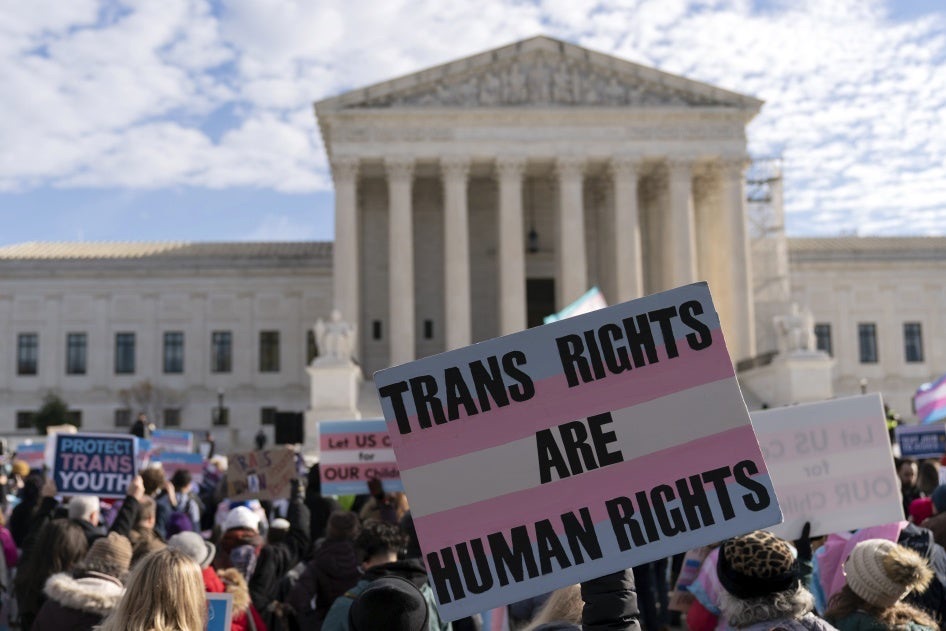

Since his earliest moments in the Oval Office, Donald Trump has blatantly attacked the transgender community in the United States. Via the establishment of several hastily-signed executive orders, the administration has made it clear their agenda to erase all mention of this community and the broader LGBTQIA+ spectrum.
For instance, one of his first uses of executive power was to dictate that the United States would henceforth only recognize “two genders”, male and female. In doing so, not only does he conflate the differing meanings of sex and gender, but he further disregards the concept of gender identity and undermines the existence of transgender and gender-nonconforming individuals.
On February 5th, his Executive Order 14201, titled “Keeping Men Out of Women’s Sports”, launched a ban on transgender women from participating in women’s K-12 and college athletics. Detrimentally, he threatens public schools that fail to comply with the elimination of their funding. Clearly, through their messaging, these orders from the White House are not made in good character, nor in the spirit of protecting women and fairness in sports, let alone the right for transgender people to compete.
Perhaps receiving more publicity, the attacks made on Diversity, Equity, and Inclusion programs (DEI) also act to weaken opportunities for people in the transgender community. By scrapping such bodies devoted to promoting fairness in hiring qualified individuals and creating safer working environments, these actions leave folks exposed to increased and unchecked workplace discrimination. Thus, the loosening of these protections signals to bigots out there that harassing trans people has no consequences and hate is tolerated, if not sponsored by our own government.
In the opinion of many, perhaps the most dangerous decision comes in the form of the concerted effort to restrict federal funding and support for transgender youth and gender affirming care. With adverse effects on the mental health and physical wellbeing of trans individuals, the administration has dictated a ban on gender affirming treatment for people under the age of 19. Trump’s White House has also pushed for an end to federal funding towards research on such care, which would have the effect of making operations that provide a lasting sense of comfort for those who undergo them, more risky and less safe.
Reacting to the past months’ anti-trans policies, Olive Bowman, a queer member of West Campus’s Gender Sexuality Alliance reports feeling “angry, helpless, and confused about the recent executive orders.” With this, they echo the thoughts of many other Americans, queer and cisgender alike. Eliciting feelings of frustration, these orders are nakedly targeted at transgender people and present this group as a threat to American life – something to be feared. This line of thought itself seems rather questionable.
But to truly grasp the danger and inaccuracies in these claims, we must first gain some insight on the nature of the transgender community itself – the supposed threat.
The Presence of People
In the United States, there are around two million adults who identify as transgender, making up less than one percent of our entire population as a nation. Of our national high school body, just around three percent of students identify as transgender, with a little more than two percent questioning whether they might be gender-queer themselves.
These are not large numbers in the least, but they are authentically representative of a community – of a group of people who choose to live their lives as they truly are. This, in itself, shouldn’t hurt anyone and in fact, there is no evidence to say it does.
Though sensationalized by the media and the rightwing corners of it, it is entirely correct to say that the existence of trans people poses no fundamental threat, and is valid through and through. For, in fact, transgender people want the same things as almost every other person on this planet wants. These are the essentially human desires of happiness, stability, acceptance, and an overall longing to be treated fairly and equally in life. On this point, Bowman puts it best when they say: “We want to exist peacefully…” “Our Identities do not threaten the identities of those who are not queer.” This is the fact of the matter and when you look at it through a lens of compassion, this comes across as normal in every respect. And that’s because it is.
Intersectionality and Marginalization
I would be remiss if I failed to identify that the hateful atmosphere faced by transgender individuals today is by no means novel. Marginalization, to those in the transgender community, serves as something to expect, because they live it every day. Their history as a community is marred by discrimination, yet paved by resistance and resilience to such oppression. And contrary to a loud belief that transgenderism is a recent fad, “fetish,” or trend, this history is a long and illustrious one indeed.
Historical accounts of transgender people in the United States date back hundreds of years. From then through today, transgender people have experienced firsthand what discrimination feels like. Not being in line with the dictations of gender norms, these people often felt the wrath of systemic and societal stigmatization. Most prevalent in the 20th century and surviving into modern-day America was the view that transgenderism was linked to mental illness, sexual and moral depravity, and predation. These unfounded and unsubstantiated claims drove, were, and still are used to justify discrimination against the trans community.
In workplaces and hospitals, harassment and injustice towards transgender people was often rife. For a transgender individual, regardless of their qualifications, to be looked over in the hiring process, denied a promotion, or fired without just cause was an acceptable trend. In the field of medicine, individuals grappling with gender dysphoria and those who were non-conformant to gender norms were often diagnosed with “gender identity disorder,” which was seen as a mental illness. To “fix” it, many people were shipped off to a fate of isolated mistreatment and cruel, unscientific experimentation in the inhumane cells of that century’s asylums.
In addition, while defending our country, the transgender servicemen in our military through WWII and beyond dealt with the expectation to conceal their true identities in order to serve. To simply come out of the closet and be who they were meant their dishonorable discharge under the army’s historical anti-LGBTQ+ policy of “Don’t Ask, Don’t Tell.”
Most sickening of all is the long history of homelessness among the trans community, especially its youth. Trans teenagers, upon realizing their identities, were often kicked out by their families because of the embarrassment having a trans child meant in a society that stigmatized the trans existence. Ostracized by practically everyone, these young people were expected to deal with the harsh realities of street life and became vulnerable and more prone to being the victims of violent crime, neglect, and abuse than their cisgender counterparts.
Even within the Gay Liberation movement, trans members were often pushed to the sidelines. Despite the strong actions of trans people like Martha P. Johnson and Sylvia Rivera at the forefront of the Stonewall Inn Riots of 1969 and their actions in the birth of a burgeoning Liberation Movement, these individuals were often marginalized by their own supposed allies. With the stigma around transgenderism penetrating the movement, oftentimes, representatives like Johnson had to push for a voice in a movement where white gay men and lesbian women took the lead and distanced themselves from the transgender people, whose identities they themselves thought to be less acceptable or palatable.
On top of these general realities is the fact that the transgender community is an intersectional group of people who may experience oppression in many forms and from many sides. Many of the community’s key figures along with the lesser-known, experience multiple forms of marginalization. For example, a black, transgender woman may deal with public ostracization for her gender identity, while also battling racism and sexism in tow.
Nevertheless, these individuals understood the needs of the transgender community and the many types of people it consists of. Together they formed organizations, such as the Street Transvestite Action Revolutionaries (STAR) to assist at-risk, homeless trans youth. Through outspoken activism and community action, transgender figures like these and those who succeeded them fought an uphill battle, but they have certainly made huge progress indeed.
Our new administration has decided to reverse this progress and eliminate all mention of it ever being made in the first place. In actions that one West Campus student labels “trangender erasure”, Donald Trump has through policy and word-of-mouth attempted to restrict the conversation of transgender existence to one of unfounded negativity and sustained ignorance. However, it is imperative that some form of this history is taught rather than where Trump is currently headed, which is omitting all references to people like Martha P. Johnson from their already limited appearances in our history books.
Striking these people and the history of transgenderism in America from the record only allows for more people to spread lies about the trans community and dehumanize them entirely. Dehumanization, as we’ve seen occur to minority after minority in history, makes it all the more easy for erasure and for governments to get rid of groups of individuals, for if nothing is taught about these groups, their struggles, their history, or their humanity, it is much easier to disassociate and hate blindly.
The Phony Issue
The way Trump and his administration’s officials are behaving relies on dehumanization to push the idea that a threat from the existence of trans people is the biggest and most dire problem of them all. In his executive orders, he describes trans women, who make up a minute amount of athletes in women’s sports and an even smaller percentage in the nation, as somehow dangerous threats to the safety and “sanctity” of women. He and other fiery anti-trans advocates push unproven stories and present hypothetical situations of men “becoming transgender” to infiltrate women’s bathrooms and violate them. On this point, there is absolutely no evidence that shows the crime rate of transgender people above that of cisgender. Likewise, it is unfounded that trans women pose a threat to cisgender women when using their preferred restroom. In truth, the evidence to suggest these hypotheticals becoming reality remains next to none.
Further undermining this argument is the insight about the transgender community which we discussed in the last two sections. Small and marginalized, and indeed lacking the institutional power to hold sway or influence over America, it is a marvel to think how they somehow threaten its children and its politics. The faults in the logic and the lack of any real evidence to support the argument of trans malevolence betrays that the argument is uncredible and phony in itself. In actuality, this means that trashing the trans community has nothing to do with any real damage they could cause, but rather their usefulness as a scapegoat – an easy distraction produced by our politicians.
Scapegoating
The answer to how trans people got placed in this position lies in the history of scapegoating and the convenience that using a scapegoat has in the realm of politics.
To find sense in the senseless, I look to history and its patterns. There we find that too often, not just in Nazi Germany, but here in America, we demonize other groups, and somehow we let ourselves believe that a marginalized minority would have the institutional power – which they haven’t been allowed to have – to somehow subvert our country.
In America’s twenties into the forties, it was the Jewish people. During this time, Henry Ford (the car guy) ran a newspaper called The Dearborn Independent, in which he pushed conspiracy theories about “The International Jew.” Here he posited that there was a global ring of Jewish people pulling the strings, an idea that became held by some influential figures in American history, like pilot Charles Lindbergh.
Then it was the communists. During the Cold War, America and right-leaning legislators launched a campaign to rid the country of communists and “un-American subversives” that became known as the Red Scare. For conservative politicians like Richard Nixon and Joseph McCarthy, the Scare became a lucrative tool. They recognized that if they could whip up enough fear of communism and accuse their political enemies of ties to communism, that – regardless of the legitimacy of their accusations – they could tank their opponents’ careers. This thus allowed them to consolidate large amounts of political power. In America — “the land of the free” as they say — belonging to a certain political organization became, with the Communist Control Act of 1954, practically illegal. And for a long time the scare worked: not in eliminating a threat but by creating a whole generation of left-leaning people who lost their credibility, their jobs, and thus their will to speak out against systemic problems and be politically active.
Then, in the wake of 9/11, the Patriot Act, passed in response to the attacks, successfully worked to demonize Arab and Muslim Americans. Described as a measure necessary to combat terrorism, this law disproportionately affected such groups and has often been criticized for its disregard of civil liberties in the encouragement of law enforcement to raid homes, offices, and mosques.
Though the list goes on and on and way farther back in time, the message is quite clear. From America’s founding, our leaders and politicians have used minorities as scapegoats and played off of fear to either gain more power for themselves, punish their enemies, or distract the populace from the real problems of the world — like racial, economic, and institutional inequality and injustice in all forms.
Distract and Deflect
In our current time, I believe that the intent to distract the American people is at the heart of what is occurring as we speak. If you look closely, you find that the scapegoating of trans people is used to shift the focus from the lack of response to the healthcare, housing, wealth inequality, and environmental crises we face. And the lack of initiative in solving these issues can be largely explained by something called corporate lobbying.
In short, corporations and private industries send representatives to Washington and state capitals across the nation to lobby on behalf of their interests. There, they advocate for their respective companies and present skewed figures and “research” to “inform” politicians on certain topics like healthcare insurance. To get the votes they need to pass laws benefiting their industry or to kill bills which don’t, these lobbyists make contributions to the election campaigns of America’s politicians, which adds up to billions of dollars every year. With over $4.4 billion spent by lobbyists in 2024, last year was the largest on record for lobbyist spending, with large sums pouring into the campaign coffers of our elected officials and candidates.
Thanks to the monetary pressure that comes with the expense of elections and reelections, and frankly an excess of greed, our politicians – the people we look towards to put forward solutions and make the American experience better for all people – too often succumb to pressure and these hard-to-resist perks offered by corporate lobbying. From there, the outcome is inevitably the same; most of our politicians, republican and democrat, are entirely bought and paid for on any number of issues.
What this spells for social and economic progress is the selling out of the American people to benefit the interests of corporations. This has already been happening in America for a long time, but with the many powerful billionaires and corporate moguls surrounding Trump as advisors and cabinet ministers, it is no doubt that this trend is accelerating. We are already seeing the effects of ensuing kleptocracy as our current federal government is dismantled to favor privatization. Trading the will of the people for the wim and zeal of corporate profit-making is not a favorable decision, for the desire of companies to make huge profits almost never aligns with what is best for the general public.
This disconnect means that when politicians are swayed to vote in favor of their corporate donors, they often loosen regulation on big business and refuse to adopt legislation which would improve the lives of American citizens. In this situation, the people who stand to get hurt are only the citizens themselves.
However, since scamming and backstabbing the American electorate is not a very good look, politicians who want to take this money and with it an oath to do right by corporations, must find a way to blame America’s problems on other groups of people. From this comes the handy-dandy idea of scapegoating – a way to cover their tracks.
This, my friends, is where sensationalizing and demonizing trans people among the public is most useful. When the will of the people is dampened by the corporate ownership of politicians, this is where we see stagnation, the worsening of our problems, and usually the angering of our citizens. But to keep the American population busy so as not cause too much outcry, politicians, almost universally on the right, go after trans people.
After shamelessly and purposefully spreading disinformation about this community, such politicians rest easy knowing that much of the American populace is divided and consumed in so-called “culture wars.” So much so that they forget to look at what the politicians are getting away with in the background. In this way, money-seeking politicians and money-dealing corporations both satisfy themselves and get what they want regardless of how it hurts the average joe. So consumed in misplaced frustration in trans people, a good percentage of America ends up voting, in many different ways and races, against their own needs and wants.
Far too late, the same people realize that the problem wasn’t trans people, but really our system. It is a system that sets up politicians to be beholden to their donors rather than their electorate. And in this system, the real solutions to the pressing issues are ignored.
As the average person suffers by seeing their problems sidelined by the politicians they elected, it goes without saying the trans community bears the brunt of this corruption and distractive play. In response to the manufactured threat of trans people, hundreds of bills have been passed on the state and national levels limiting their freedoms, stripping their rights, and demeaning their characters. Olive Bowman is sure that this negative campaign of disinformation and the scapegoating of their community is not without consequence. They worry that actions like these will work to “promote violence towards the queer community, or at least make it very difficult for us to exist in public.” Recent statistics hold this to be true, as over the past four years, violence against trans people has doubled, no doubt thanks to such a campaign.
Wake Up
Until we, the people, educate ourselves and call out anti-trans arguments for what they really are – lies and diversions – we, whether straight or queer, will lose. We will see all of our problems ignored and all of our needs neglected by the politicians who are too absorbed in the precious exchange of cash to care.
No doubt, we are already experiencing this; But by brushing hateful distractions aside, and giving them no platform, we can get at the real issues. We must talk about the wealth gap that means the rich have more money than they could ever possibly spend, while the poor can barely survive. We must talk about healthcare, and how the cost of insurance and medical coverage is out of reach for millions of people, keeping millions more without the means to receive the care they desperately need, including the gender affirming care for transgender people. Or perhaps we could talk about climate change, or for-profit prison systems. How about addressing a justice system filled with racial disparities or discussing how students like us want to come to school and feel safe – not like someone with a military-grade weapon will mow us down in our own classrooms. Suffice it to say, there is so much to fix and so much that is draining American society, yet so little action is being taken to make this country “great again.”
When we recognize the pattern of scapegoating and communicate to our leaders that we will be fooled and distracted no longer, then, and only then will we begin to see the results we so desperately want and deserve. For certain, working and middle class Americans, and the trans people among them, have a right to see their problems discussed and solved. We all deserve better. And to achieve this, we need to take things into our own hands and start demanding it. And for this to occur, there can be no division, hate, or distraction – only action.