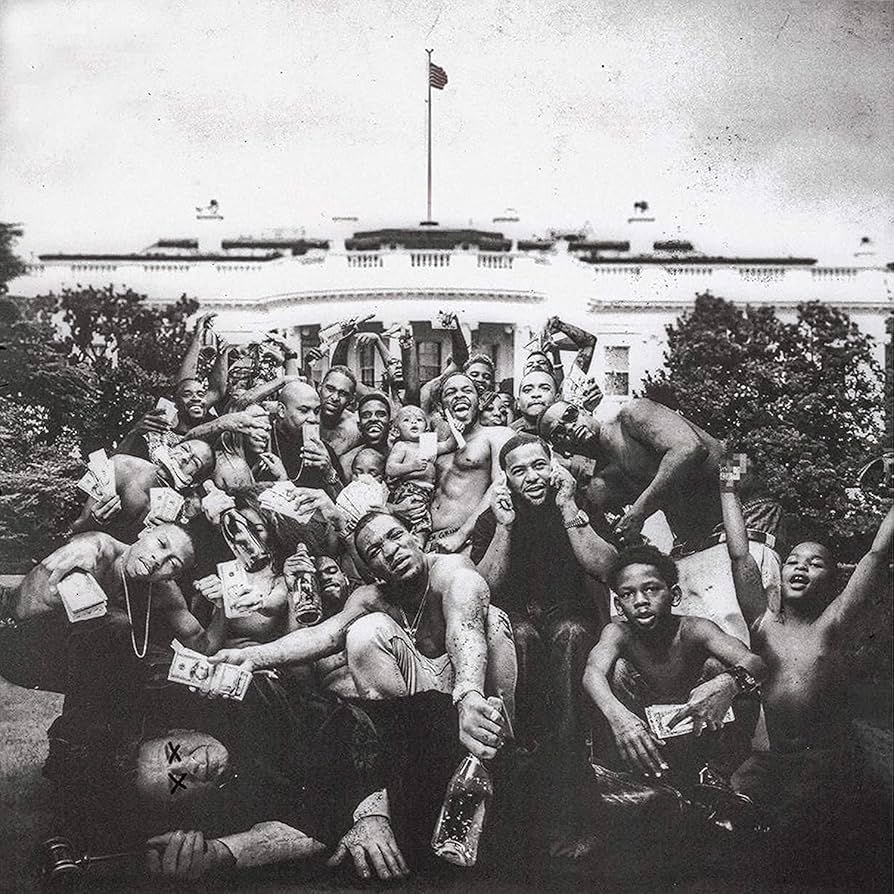

To Pimp a Butterfly
| Kendrick Lamar | 2015 | Rap/Hip-Hop, Jazz Rap |
| 1h 19m | 16 Tracks | Notable Features: Thundercat, Anna Wise, Snoop Dogg, Rapsody |
Ten years ago today, Kendrick Lamar released his most critically acclaimed album, To Pimp a Butterfly. As his third studio album, it has been hailed as one of the best rap albums of the modern age, and some even claim it to be one of the best rap albums ever. Lamar explores themes of institutional racism, capitalism, and humanity effectively and cleverly. Many of the topics and subjects brought up in the album are still relevant today despite its release a decade ago.
Background
Hailing from Compton, California, Kendrick Lamar started his rap career as a teenager. His fourth mixtape, Overly Dedicated was introduced to hip-hop producer and legend Dr. Dre, who later reached out to Kendrick to join his record company Aftermath Entertainment. His first studio album Section.80 was a success and the start of the style he is known for today, with social commentary being a major part of his music. However, his second studio album good kid, m.A.A.d city shot Kendrick into superstardom. Kendrick explores his life in Compton and his shift away from the violence and gang culture he grew up in. It debuted at number 2 on the Billboard Top 100 chart and was nominated for 7 Grammys, including Album of the Year, making it the first West Coast hip-hop album to be nominated for the award. Before the recording of To Pimp a Butterfly, Kendrick took a trip to South Africa which inspired many of the songs on the album. Additionally, songs originally cut from the album were released in a compilation album named Untitled, Unmastered in 2016.
Synopsis
To Pimp a Butterfly is a concept album tackling themes of race, capitalism, and the music industry. The production is heavily influenced by jazz, funk, and soul, all genres that originated from African Americans. The story of the album focuses on Kendrick’s journey from his greed and decadence after his mainstream success, to learning what it means to be a black man in America and spreading his message to his community.
Production
Kendrick utilizes many different musical genres and styles to help tell the album’s story. Almost all the songs on the album have a heavy jazz influence, with only a few exceptions. Jazz originated from black communities in New Orleans, and its inclusion connects to the commentary present on the album about music and race. Some tracks that show the most jazz influence include Wesley’s Theory, For Free?- Interlude, and Alright. Of course, hip-hop production is mixed in with the jazzy instrumentals in songs like Alright and King Kunta. Legendary producer and songwriter Pharrell Williams lends his production to Alright, and he even performs the hook. Another heavy influence found in the album is funk. Producers such as Thundercat contribute to the album with funky bass lines such as in Wesley’s Theory and You Ain’t Gotta Lie (Momma Said). These Walls and Complexion (A Zulu Love) slow the album down by adding R&B-inspired elements, adding additional variety. The Blacker the Berry uses a piercing electric guitar that’s almost siren-like to add tension to the song. i utilizes a live rock band to create an uplifting anthem that Kendrick uses to elevate the citizens of Compton.
Lyrics and Story
Being a primarily rap album, the lyrics are the most important and focal part of the album. Kendrick raps from the perspectives of multiple people, personas, and himself as the story develops. His signature use of different voices and flows adds variety to the album.
The first track Wesley’s Theory starts the story with Kendrick riding off his success after good kid, m.A.A.d city. He brags about all the money, objects, and partying he’s going to indulge in with his newfound success. However in the middle of the song, Dr. Dre sends Kendrick a message, “You said you wanted a spot like mine. But remember, anybody can get it, the hard part is keeping it motherf*****”. He is telling Kendrick that anyone can achieve success in the music industry, but most people lose themselves in the indulgence and lose their spot in the industry.
Another one of the major themes in the album is established in the following verse, where Kendrick voices a character known as Uncle Sam, a representation of the U.S. government and White America. Uncle Sam tempts Kendrick with expensive belongings, “What you want you? A house or a car? Forty acres and a mule, a piano, a guitar?”. The line “forty acres and a mule” is historically and symbolically important for the album. The line was most famously uttered by Union General William T. Sherman during the Civil War, promising the freed slaves of the Confederacy land and resources to support themselves. However, after President Andrew Johnson took over after Lincoln’s assassination, the land was taken from them and given back to the former Confederates. The phrase has now become infamous due to this, and represents the failure of the U.S. to successfully help African Americans during Reconstruction and even now. Uncle Sam is promising Kendrick, and by extension other black artists in the music industry, with all the glitz and glamor of success, but is secretly manipulating them to get them to lose their success, just as Dre warned Kendrick previously. However, in the following tracks, it becomes clear Kendrick did not listen to his advice.
In For Free?, an unnamed woman goes off on Kendrick, demanding he buy her many different expensive things. Kendrick in turn tells her that he’s not going to have her take his money for her to satisfy her greed, The woman could be interpreted to represent America as well, as at the end of the interlude she threatens to get her uncle Sam, and mocks Kendrick for thinking he’s a king.
King Kunta continues the story of the album, where Kendrick goes back to Compton. After his success, he parades around the streets asking the people where they were before he got his success. He acts like he’s the king of Compton now. The song is named for a character from the novel Roots: The Saga of An American Family. In the novel, Kunta Kinte is a slave brought to America who defies his captors. Kendrick calling himself King Kunta could suggest him rebelling against whoever stands in his way, but also him being under the control of Uncle Sam and the music industry. The song ends with the spoken word line “I remember you was conflicted, misusing your influences”. Kendrick narrates the story, explaining that his success gave him a platform to do good, yet he chose to instead indulge in the power and fame.
Institutionalized tells the story of Kendrick bringing his friends to the BET Awards. His friends see all the wealth around them and plan to steal watches and jewelry. They justify their actions by explaining they’re simply taking from the rich and giving back to the poor, and ask him if they are in a recession then how come the people around them are so wealthy. To be institutionalized is to have your thoughts and actions shaped by the environment you are in, like how growing up struggling shaped his friends’ views on the world. The title could also allude to institutionalized racism, a form of discrimination in which race leads to oppression in political, social, or economic systems. This type of ingrained discrimination is what most likely leads to his friend’s attitudes toward money and wealth.
Track 5, These Walls, furthers the themes of indulgence. The song adds to the poem started in King Kunta, adding the line “sometimes I did the same”. At the end of the song yet another set of lines is added, “Abusing my power full of resentment, a resentment that turned into a deep depression. I found myself screaming in a hotel room”.
The previous song cuts out and you hear Kendrick screaming. In track 6, u, Kendrick is talking to himself. He criticizes himself for his inability to help his community and his family members. The song takes an even darker turn, as a skit in which Kendrick is lying silent as a housekeeping lady knocks on the door. The song switches to its second part, where he drunkenly starts listing all the things he hates about himself. He calls himself selfish, irresponsible, and a burden, blaming himself for the death of one of his close friends. Kendrick cries softly as he proceeds to further go down a rabbit hole of self-hatred.
However, something changes. In Alright, he proudly proclaims the now iconic phrase “We gon’ be alright”. He finally realizes that both the music industry and Uncle Sam are using him for their profits whilst lowering his power. In the song, Kendrick reuses the lines previously said by Uncle Sam, however, he reveals that the person who really said the line was Lucy, the devil. This shows that Kendrick has now opened his eyes and realized that all the promises given to him when he joined the music industry were temptations aimed at bringing him down.
The second interlude, For Sale? is a counterpart to the first. Kendrick now speaks from the perspective of Lucy, further showing the temptations Lucy gave him. However, he breaks away from Lucy. Kendrick in the last song said he went running for answers, but he wouldn’t find his answers until he came home. Kendrick returns to Compton in Momma, track 9. His city welcomes him home, and he starts claiming he knows everything. He knows morality, wisdom, the streets, money, and respect, and he claims to know numerous other things.
Hood Politics continues Kendrick’s reflection in Compton. He shows the perspective of the people, they don’t want to listen to his preaching and just want him to make music that they can shut their minds off to. His return to Compton hasn’t been what Kendrick expected to be. However, Kendrick was about to face a new challenge 10,000 miles away.
How Much a Dollar Cost tells the story of Kendrick in South Africa. He exits a gas station and finds a homeless man. The man asks him for a single dollar in order to help feed himself. Kendrick refuses, angry at the fact the man is simply begging for money instead of earning it through work. The man stares at him, and Kendrick stares back. The man asks Kendrick if he has read the Bible, quoting a passage about giving to the poor. Kendrick feels like the man is just trying to guilt trip him, and still refuses. However, the twist of the song occurs as the man reveals himself to be God himself. Kendrick’s greed and unwillingness to give a single dollar cost him his spot in heaven.
The tone switches in Complexion (A Zulu Love). In this song, Kendrick tackles the issue of colorism in the black community. He traces its roots to practices in slavery. The song tells the audience to love each other regardless of skin tone, a message that can be applied not just to African Americans but to other groups as well. One of the only guest verses on the album is performed by female rapper Rapsody. She tells the story of her childhood, growing up, and being ashamed of her skin color. However, she eventually learns to love herself and rejoices that girls like her nowadays won’t be insecure about their complexions.
The previous song’s euphoric ending is turned on its head, as a sinister electric guitar and piano start track 13, The Blacker the Berry. “I’m the biggest hypocrite of 2015,” is the line that starts each verse of the song, and the following line “once I finish this witnesses will convey just what I mean,” foreshadows the ending verse. Kendrick is the angriest he’s sounded on this record. He asks, either White America or the police if they hate him, his people, and his culture. His frustration and anger is felt through his aggressive rapping. He accuses the government of sabotaging black communities, causing gang violence and struggles. The hook repeats the phrase “The blacker the berry, the sweeter the juice”, most likely referring to White America exploiting black people for their benefit. However, the final line of the hook changes the phrase to, “the blacker the berry, the bigger I shoot”, referring to either gang violence or racism in the police system. The song ends with Kendrick delivering one of the most impactful lines of the album, “why did I weep when Trayvon Martin was in the street when gang-banging make me kill a n**** blacker than me? Hypocrite!”. Of course, Trayvon Martin was a 17 year old black teen who was shot by a 28 year old man in Sanford, Florida. Kendrick considers himself a hypocrite, as he was deeply affected by the boy’s death despite the fact his past life as a gang member made him kill his people.
After the intense lyrics of The Blacker the Berry, a more uplifting message is given in You Ain’t Gotta Lie (Momma Said). Kendrick tells the advice his mom gave him once, you shouldn’t change who you are just to appear cooler. Many hip-hop artists have faced challenges gaining record deals due to them not conforming with the aesthetics popular at the time. For example, Kanye West originally was rejected by his record company, as they thought he wouldn’t sell due to his “soft” image. Of course, the message is universal, “You ain’t gotta try so hard”. As the song wraps up, you can hear a crowd forming to hear a live performance.
An MC introduces the crowd to the returning star, Kendrick Lamar, who has just returned to Compton after his time in South Africa. Kendrick now preaches self-love in the song i, a direct counterpart to u. He proudly proclaims, “I love myself!”, and explains that even through all the hardship and tragedy he still has kept his head up high and learned to love himself. He preaches his newfound purpose to the people of his community, elevating the people of his hometown. However, the show is interrupted by a fight that happens in the crowd. Kendrick sees this and stops the music, reprimanding the people involved for disrupting the innocent show for the young people of Compton. He decides to move on with the show by doing some acapella rapping. He decides to educate the audience on the origins of the n-word, a sensitive subject within the black community. However, his time in Africa has opened his eyes to a new form of empowerment. He explains there is a similar word “negus” originating in Ethiopia. The word means a black king or royalty. He uses this connection to empower the people he speaks to, changing a hateful and divisive word into a powerful statement. The people are silent and listening to what he is saying during the speech. Kendrick has finally achieved his goal of opening the people of Compton’s eyes.
Mortal Man, track 16, is the conclusion of the album. Kendrick has gone from arrogant and selfish, to enlightened, and has successfully spread his message to the masses. His journey has ended, however he still needs to spread his message to one last group, the audience. He tells us that this album was aimed at opening our eyes to injustice and inspiring us to fight it. Finally, the poem started in King Kunta is completed, with the full poem reading,
“I remember you was conflicted, misusing your influence. Sometimes I did the same. Abusing my power, full of resentment. Resentment that turned into a deep depression. Found myself screaming in the hotel room. I didn’t wanna self destruct. The evils of Lucy was all around me, so I went running for answers. Until I came home. But that didn’t stop survivor’s guilt. Going back and forth trying to convince myself the stripes I earned, or maybe how A-1 my foundation was. But while my loved ones was fighting the continuous war back in the city, I was entering a new one. A war that was based on apartheid and discrimination. Made me wanna go back to the city and tell the homies what I learned. The word was respect. Just because you wore a different gang color than mine’s, doesn’t mean I can’t respect you as a black man. Forgetting all the pain and hurt we caused each other in these streets. If I respect you, we unify and stop the enemy from killing us. But I don’t know, I’m no mortal man, maybe I’m just another n****”.
Kendrick puts down his paper, as he starts talking to a man he’s interviewing. Kendrick asks this man about a metaphor he once made about the ground. The man is Tupac Shakur, aka 2Pac, a legendary rapper of the early 90’s who was killed when he was only 25. In an archived recording, 2Pac explains that the ground represents the poor people of the world, who will one day rise up and swallow the rich people of the poor. Kendrick and 2Pac exchange more conversation, and Kendrick asks him what will happen when the people fight back. He predicts that the next time there is an uprising, it will be violent and angry due to the mistreatment of the African American population. Kendrick is shocked by the revelation, but continues on. He reads him another poem his friend had made, and asks for his opinion. the poem reads,
“The caterpillar is a prisoner to the streets that conceived it. Its only job is to eat or consume everything around it, in order to protect itself from this mad city.”, “One thing it noticed is how much the world shuns him, but praises the butterfly. The butterfly represents the talent, the thoughtfulness, and the beauty within the caterpillar. But having a harsh outlook on life the caterpillar sees the butterfly as weak and figures out a way to pimp it to his own benefits. Already surrounded by this mad city the caterpillar goes to work on the cocoon which institutionalizes him.”, “When trapped inside these walls certain ideas take roots, such as going home, and bringing back new concepts to this mad city. The result? Wings begin to emerge, breaking the cycle of feeling stagnant. Finally free, the butterfly sheds light on situations that the caterpillar never considered, ending the internal struggle. Although the butterfly and caterpillar are completely different, they are one and the same.”
Of course the caterpillar is the people living in the struggling areas such as Compton, who are unaware of the issues going on. However, through opening their eyes to the issues of the world and that they are going through, it evolves into the butterfly. The butterfly in this case are people like Kendrick and Tupac who arose from their struggles to spread their message to the world. Kendrick asks him what he thinks of the poem, but Tupac never responds. He stays silent as Kendrick calls out to him.
Reception and Impact
After its release, To Pimp a Butterfly received almost universal acclaim. The album was nominated for seven Grammy awards, including Album of the Year, and ended up winning five, including Best Rap Album. In December 2023, Rolling Stone included it in its “500 Greatest Albums of All Time” list at number 19. The political and social commentary of the album also influenced movements later on. The song Alright became an anthem in the Black Lives Matter movements, with the hook “we gon’ be alright” becoming a popular chant. The album has also influenced other artists. The album was a large influence on David Bowie’s final album Blackstar, which was released shortly before his death in 2016.
Conclusion
To Pimp a Butterfly utilizes Kendrick Lamar’s skills in rapping and storytelling to tell the story of a sinful man overcoming his troubles for the good of his community. While the issues and history of African American culture is essential to the album, the themes and messages present are universal. Prize. If you’re interested, I’d highly recommend giving it a listen. The album is best enjoyed when you form your own opinion and dive deep into the lyrics. In fact, I probably missed some large references, and my interpretations could be wrong. There’s hours of content about this single album, dissecting every song extensively. Give it a listen! Even if you don’t care about that, the music itself is great to listen to. 10 years later, it still feels new and is able to be enjoyed over and over again.